
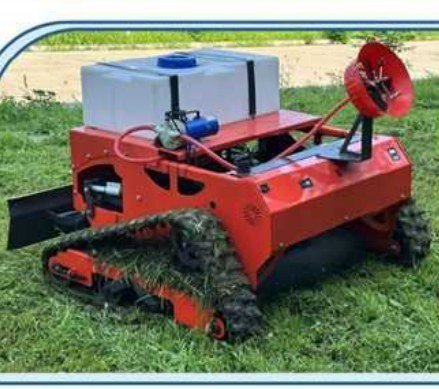
The short answer: a remote control lawn mower is bought for the ground you cannot or should not mow with a ride-on — embankments, highway verges, retention basins and overgrown plots. Before you compare prices, confirm the slope angle, the grass type and height, the distance you need to stand from the machine, and how the mower behaves when the track loses grip.
Remote mowers are usually bought after an incident, a near miss, or a quote from a contractor that was too high. The machine removes the operator from the slope, but it does not remove the risk. Steep ground, loose surfaces and hidden obstacles still decide whether the day goes well.
Slope angle is the first number, and the most misquoted
Every supplier quotes a climbing angle. Ask how it was measured: on grass, on dry soil, with a full load, at what speed, and with which track. A machine that climbs 45 degrees on a test ramp behaves differently on a wet embankment with tall grass.
Practical approach:
- Measure the slope on the site, not on the drawing. A phone inclinometer is accurate enough.
- Take the steepest 20 m section, not the average.
- Add the grass height to the calculation. Tall grass hides holes and reduces track grip.
- Keep a margin: if the worst section measures 35 degrees, do not buy a machine rated at exactly 35.
Cutting width, weight and the ground under it
Wider decks cover more ground per pass but add weight and reduce stability on slopes. A 500 mm tracked mower weighs around 105 kg and is easy to move between sites; a 550 cc machine at 260 kg cuts faster but needs a wider access route and more careful transport.
Check the ground as carefully as the slope. Wet clay, sand and loose gravel all reduce grip. A machine that works well on a dry bank in July can slide in October.
Remote range, line of sight and failsafe behaviour
The remote is not a toy controller. Confirm the working range in open ground, and confirm what happens when the signal drops. A mower should stop, not keep driving. Ask the supplier to demonstrate the failsafe with the machine on a slope, not on flat concrete.
Line of sight matters more than range. If you cannot see the mower, you cannot stop it in time. On long verges, plan to work in sections that keep the operator within sight, even if the remote claims 100 m or more.
Blades, grass type and the finish you need
Remote mowers are usually fitted with swinging blades or fixed flails. Swinging blades give a cleaner cut on lawn-height grass but suffer on woody stems. Flails handle rough growth and debris but leave a rougher finish.
Match the blade to the work:
- Maintained turf and park grass: swinging blades, higher blade speed
- Overgrown plots, bracken, brambles: flail or heavy-duty blade set
- Verges with litter and debris: flail, with a guard that contains thrown objects
Ask what happens when the blade hits a stone at full speed. The answer tells you more about the design than the cutting width does.
A trial protocol before you buy
Run the mower on your own ground, in the worst condition you expect, not in a car park.
Stop the trial if the mower continues to move after the remote is switched off. That is not a feature to work around.
Transport, storage and the practical side
A tracked mower is awkward to move. Check whether it fits a trailer or a pickup bed with the deck folded, and whether the tie-down points are strong enough for road transport. Check the battery and remote charging routine — a mower that is flat when the crew arrives costs a day.
Also check the spare parts you can actually get: blades, tracks, remote batteries and controllers. A machine with a proprietary controller and no local stock is a machine that stops for weeks.
FAQ
Can a remote mower work on a 40 degree slope?
Some models are rated close to that, but the rating is measured in defined conditions. Confirm the angle with the grass height, surface and load you actually have, and keep a margin.
How far can the operator stand from the mower?
Range varies by model and terrain. Line of sight is the real limit — if you cannot see the machine, you cannot stop it safely.
Are remote mowers safe near roads?
They are used on verges, but the site still needs traffic management, a spotter and a plan for thrown objects. The remote does not replace those controls.
Tracked or wheeled — which is better on slopes?
Tracked machines generally hold slopes better and spread load over a larger area. Wheeled machines are faster on flat, maintained ground.